
Concrete Coatings, Supplied and Installed in Southern California
Epoxy, polyaspartic, urethane cement, MMA, sealers and densifiers, decorative overlays, deck coatings and the repair products that go down first. We stock all of it at our Corona warehouse, install it with our own crew across Riverside, San Bernardino, Orange, Los Angeles and San Diego counties, and teach contractors to run it in a two-day class. This page sorts every coating by the job it does.
Which concrete coating does your slab need?
Every type of concrete coating we stock
Prices are counter prices at the Corona warehouse today. Each family links to its own page with the full product list, data sheets and install details.
Epoxy coatings
Best for: Garages, shops, warehouses, showrooms, any interior slab that needs a hard, seamless floor
The body coat under most garage, shop and warehouse floors. 100% solids for build and wear, water-based for primers and occupied spaces, clear for metallic pours.
- E-FLO P100 100% Solids Epoxy, 3 gal$137.89
- Kretus Top Shelf Epoxy (100% Solids)$195.88
- Kretus WB Epoxy (Water-Based)$119.18
- Kretus Metallic Epoxy Clear, 3 gal$210.22
Polyaspartic & polyurethane topcoats
Best for: Every exterior or sunlit floor, fast-turnaround jobs, flake and quartz topcoats, ESD floors
The UV-stable wear layer over epoxy and flake. Cures in hours, holds color in sunlight, takes the scratches so the body coat doesn't.
- Kretus Polyaspartic$200.26
- Kretus Polyurethane (HP & HS)$312.42
- Increte WB Urethane (Euclid)$243.20
- Kretus Polyaspartic Dissipative, 1.5 gal$280.21
Urethane cement
Best for: Commercial kitchens, food and beverage, breweries, washdown areas, heavy industrial
Cementitious urethane slurry and mortar for floors that see hot water, thermal shock, forklifts and aggressive chemicals. The commercial kitchen and food-plant floor.
- Kretus Urethane Polymer Concrete (UPC)$139.38
- Kretus UPC Roll Coat$205.11
- EucoFloor Epoxy Primer (Euclid)$481.35
MMA (methyl methacrylate)
Best for: Cold storage, 24-hour facilities, exterior work in cool weather, fast turnarounds
Cold-cure acrylic systems that go down and return to service in about an hour, even in a freezer or at night.
MMA flooring →Sealers, densifiers & cure-and-seals
Best for: Warehouse and polished floors, new pours, stamped driveways, patios, decorative concrete
Penetrating densifiers harden and dustproof a slab from the inside; film-forming sealers protect and bring up color on stamped and stained concrete; cure-and-seals go on new pours.
- Euco Diamond Hard (Euclid)$137.06
- UltraSil Li+ (Euclid)$189.09
- Diamond Clear VOX cure & seal (Euclid)$101.08
- Seal Brite acrylic sealer (Multicoat)$74.00
- Acrathane Colorseal (Multicoat)$71.44
- Premera Crystal Densifier$146.25
Decorative overlays & stains
Best for: Patios, pool decks, driveways, walkways, interior floors that need a new look
Thin cementitious overlays, stamp mixes and stains that give old concrete a new surface without tearing it out: stamped, troweled, polished or stained.
- Krete Kote 2000 overlay (Multicoat)$77.38
- Scratch Kote 2000 (Multicoat)$73.31
- Stamp Mix (Multicoat)$57.92
- Level Top PC-AGG polishable overlay (Euclid)$55.21
Deck & waterproof coatings
Best for: Pool decks, balconies, walkways over living space, slabs with vapor drive
Elastomeric membranes and moisture barriers for slabs that have to keep water out or stop it coming up.
- Mulasticoat deck coating (Multicoat)$71.00
- Vapor Shield moisture barrier (Multicoat)$54.00
- Green Barrier (Multicoat)$52.31
Repair, patch & joint fill
Best for: Every job, before step one
Fix the slab before any coating goes on: polyurea joint filler, fast-set crack repair, vertical and horizontal mortars.
- Euco QWIKjoint UVR (Euclid)$600.40
- Euco QWIKstitch crack repair (Euclid)$577.60
- Duralflex Fastpatch (Euclid)$179.99
- Kretus Top Shelf Epoxy Patch$153.88
Concrete coatings compared
| Coating | Where it belongs | Strength | Limit | Starts at |
|---|---|---|---|---|
| Epoxy | Interior floors: garages, shops, warehouses | Hard, high build, economical | Yellows in UV; needs a topcoat outdoors | E-FLO P100 from $137.89 |
| Polyaspartic / polyurethane | Topcoat over epoxy, exterior, fast turnaround | UV-stable, fast cure, scratch resistant | Thin on its own; costs more per gallon | Kretus Polyaspartic $200.26 |
| Urethane cement | Kitchens, food plants, thermal shock | Takes heat, water and chemicals | Heavier install, specialty crews | Kretus UPC from $139.38 |
| MMA | Cold rooms, overnight work | One-hour cure at any temperature | Strong odor during install | Ask the counter |
| Sealer / densifier | Decorative and bare concrete | Cheap, fast, no film to peel (densifier) | No build; acrylics recoat every few years | Diamond Hard $137.06, Seal Brite $74 |
| Overlay | Patios, pool decks, driveways | New surface and color without demo | Needs a sealer; prep still matters | Krete Kote 2000 $77.38 |
| Elastomeric deck coating | Pool decks, balconies, walkways | Waterproofs, bridges hairline cracks | Not for forklift or hot-tire floors | Mulasticoat $71 |
Every product's technical data sheet is the authority on prep, coverage and cure. See technical data or ask at the counter.
The coating is 20% of the job. Prep is the rest.
Nearly every peeling floor we're called to fix had the same three problems: the slab wasn't ground, moisture wasn't tested, and cracks were coated over instead of repaired. The brand on the bucket had nothing to do with it.
Grind, don't etch
Diamond grinding opens the slab and removes old sealer, paint and laitance. We rent Husqvarna grinders and dust extractors for the day, and sell the tooling to match the slab.
Test for moisture
Slabs on grade without a vapor barrier push moisture up through any coating. A calcium chloride or RH test tells you whether you need a moisture barrier or a moisture-tolerant primer first.
Repair, then coat
Joints get polyurea filler, cracks get fast-set repair, spalls get mortar. A coating does not bridge a moving crack; it telegraphs it.
Match the coating to the exposure
Epoxy inside, polyaspartic on top, urethane cement where there's heat and washdown, elastomeric where it has to keep water out. The guide above and the people at the counter will keep you from buying the wrong one.
Want to learn it properly? The two-day hands-on class in Corona runs real floors with the same material and grinders you buy here.
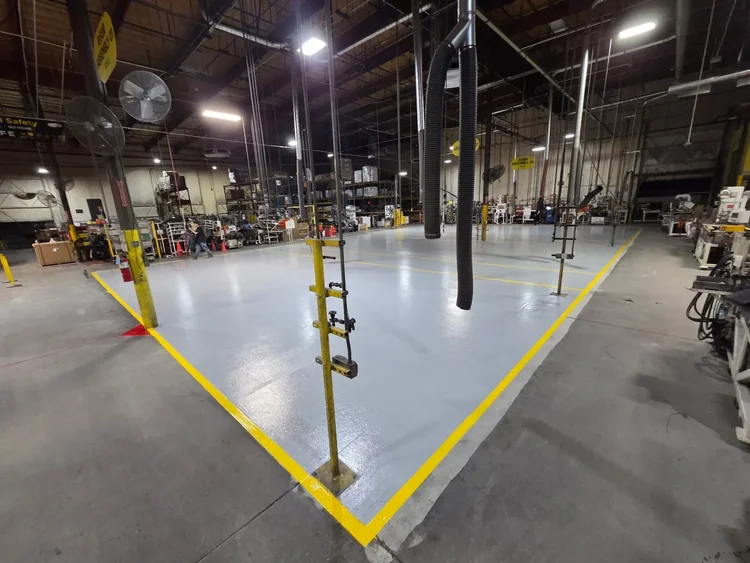
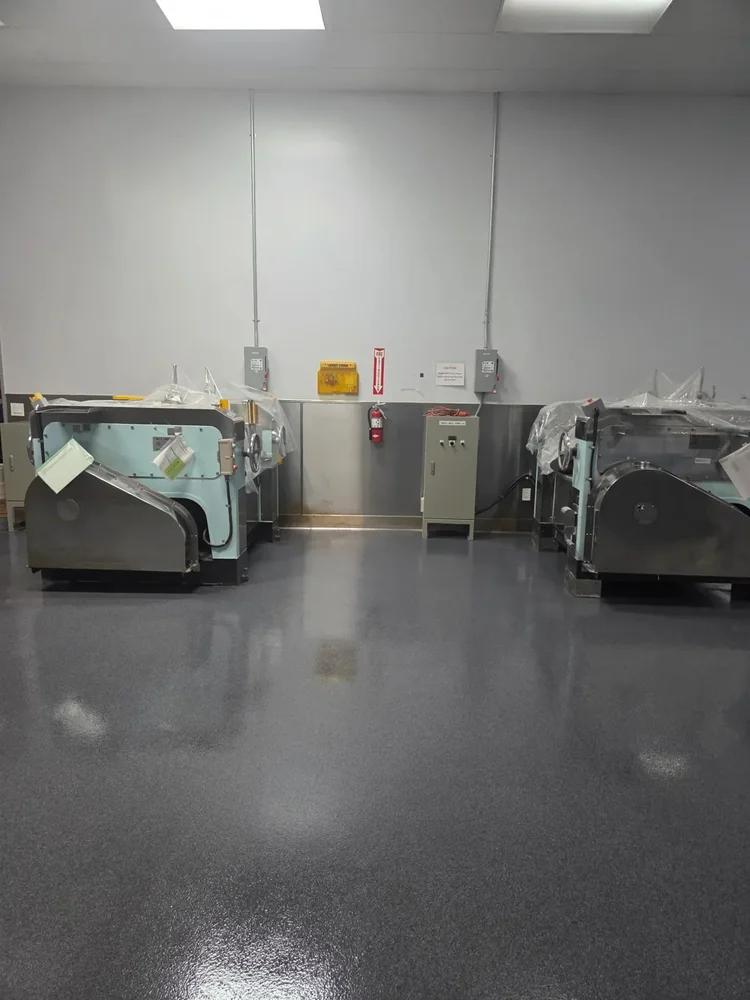
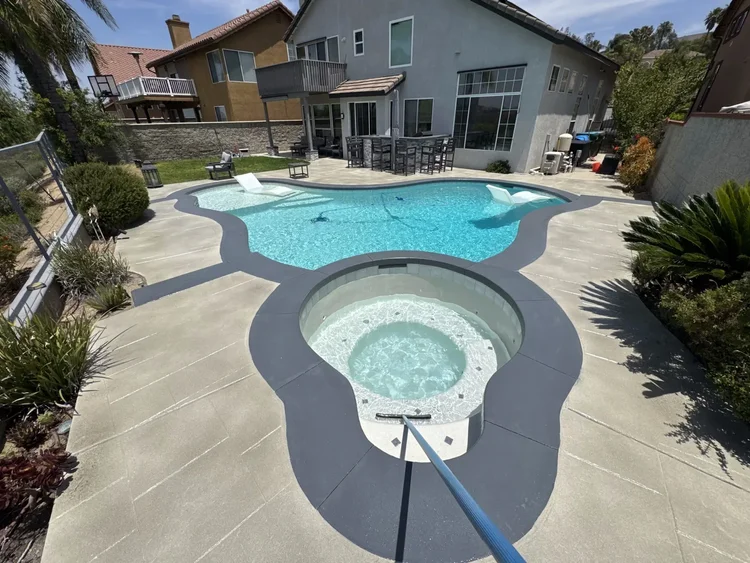
Coatings we have installed
Concrete coating questions
What is a concrete coating?
Anything applied to a concrete slab to protect it, make it cleanable or change how it looks: resinous floor systems (epoxy, polyaspartic, urethane cement, MMA), penetrating sealers and densifiers, film-forming sealers, cementitious overlays and elastomeric deck coatings. They are not interchangeable. The right one depends on whether the slab is inside or out, what rolls over it and what gets spilled on it.
What is the best coating for a concrete floor?
For an interior garage, shop or warehouse: 100% solids epoxy, usually with flake or quartz and a polyaspartic topcoat. For a commercial kitchen or food plant: urethane cement. For an exterior patio, pool deck or driveway: an overlay with a sealer, or an elastomeric deck coating where it has to waterproof. For a slab that only dusts: a densifier. We stock and install all of them and will tell you which one fits the slab, not the one with the highest ticket.
How much do concrete coatings cost in Southern California?
Material from our Corona counter: epoxy body coat from $137.89 for a 3 gallon E-FLO kit (about 390 sq ft a coat), polyaspartic topcoat $200.26, densifier $137.06, acrylic sealer $74, overlay $77.38 a bag. Installed by our crew, flake floors run about $5.50 to $6.50 per sq ft, metallic and quartz $10 to $14, with prep extra; overlays and commercial systems are quoted by spec. The California epoxy cost page has the full breakdown.
Can I coat concrete myself?
Yes, and most of our customers are contractors or owners doing exactly that. The failure point is prep, not the coating: grind the slab (we rent the grinders), repair cracks and joints, check moisture, then follow the TDS. Our two-day hands-on class in Corona teaches the full sequence on real floors.
How long do concrete coatings last?
A properly prepped epoxy floor with a polyaspartic topcoat runs 10 to 20 years in a garage; urethane cement in a kitchen 10 plus; densifiers are permanent because they react inside the slab; acrylic sealers on decorative concrete get recoated every 2 to 4 years. Coatings over unprepped or damp concrete fail in months regardless of brand.
Do you install or just sell?
Both. Empire Coating Solutions installs across Riverside, San Bernardino, Orange, Los Angeles and San Diego counties, stocks the same material at the Corona warehouse for contractors and owners, rents the grinders and runs the training class.
Which brands do you carry?
Kretus (epoxy, polyaspartic, urethane cement), E-FLO (our own industrial epoxy), Euclid Chemical (densifiers, cure and seals, repair, Level Top overlays), Multicoat (overlays, deck coatings, sealers, stains), Premera (sealers and densifiers), Torginol flake, Vantage metallic pigments and Husqvarna grinders and tooling.
Tell us about the slab
Square footage, inside or out, what it has to stand up to. We'll match the coating, price the material, and quote the install if you want our crew on it.