
Commercial & Industrial Floor Coatings
Warehouses, food plants, labs, hangars, gyms and retail across Southern California
Empire Coating Solutions has supplied and installed resinous floors for commercial and industrial facilities since 2000. One call covers the spec, the material and the crew: 100% solids epoxy, urethane cement, polyaspartic, MMA and quartz systems, prepped and installed around your operations.

Floors we build, by facility
Every building type wears a floor out differently. Pick yours to see the systems we spec for it, or call and describe the space.
Warehouses
Forklift aisles, racking bays, dock plates and battery charging areas. Joint repair, 100% solids epoxy with aggregate, safety striping.
Warehouse floor coatings →Kitchens & food processing
Urethane cement with integral cove base, slope to drain and a textured finish for commercial kitchens, food plants, breweries and wineries.
Food processing flooring →Aircraft hangars
Hermetic aircraft flooring built for Skydrol, fuel, tug traffic and tie-down loads, with a light-reflective finish for inspection work.
Hangar flooring →Fire stations
Apparatus bay floors that take diesel, hose washdowns and 40,000 lb rigs, with a slip-resistant texture that still hoses clean.
Fire apparatus floors →Gyms, retail & showrooms
Seamless, easy-clean floors that take dropped weights, rolling racks and daily foot traffic. Solid color, flake, quartz or metallic.
Shop & gym floors →Schools, labs & government
Classrooms, labs, maintenance bays and military facilities. Low-odor systems, chemical resistance and installs scheduled around breaks and shifts.
School flooring guide →Coating systems we spec and stock
Most commercial floors are one of these six systems, or a combination zoned across the building. All of them ship from our Corona warehouse, and our crews install them.
| System | Typical build | Best for | Watch for |
|---|---|---|---|
| 100% solids epoxy | 2 to 3 coats, roughly 20 to 40 mils; broadcast aggregate for traction | Warehouses, manufacturing, showrooms, labs, auto bays | Not for thermal shock or standing hot water; needs a UV-stable topcoat where daylight hits |
| Urethane cement | Trowel or slurry, 1/8 to 1/4 inch; Hermetic 4.8S slurry | Commercial kitchens, food processing, breweries, freezers, washdown areas | Thickest and most involved install; drains and cove base should be planned with it |
| Polyaspartic | Topcoat over epoxy, or a two-coat fast system | Fast turnarounds, retail, offices, anything with daylight | Short pot life; an experienced crew matters |
| MMA (methyl methacrylate) | Fast-cure resin, cures in about an hour even in the cold | Cold storage, freezers, overnight retail and grocery work, exterior ramps | Strong odor during install; ventilation plan required |
| Quartz broadcast | Double-broadcast colored quartz in epoxy or polyaspartic | Locker rooms, restrooms, kitchens, pool decks, schools | Texture level has to be chosen for the cleaning method |
| Hermetic industrial mortars | Neat, Stout, Paramount and Paramount HD, 40 to 250 mils | Heavy forklift traffic, impact zones, production floors | Specified by load; send us the equipment list |
Need a static-dissipative (ESD) floor for electronics or lab work, or a novolac system for secondary containment and battery rooms? Those are specified job by job. Call 909-272-5137 with the standard you need to meet and we will send a system data sheet.
How a commercial floor job runs
The coating is the last 20 percent of the work. The first 80 percent is what decides whether it is still there in ten years.
Site walk & spec
We look at the slab, drains, joints, traffic and chemicals, then write the system, thickness and texture for each zone.
Moisture testing
In-slab relative humidity (ASTM F2170) or calcium chloride (ASTM F1869). Wet slabs get a vapor barrier primer, not a guess.
Surface prep
Diamond grinding or shot blasting to the ICRI profile the system calls for, plus crack, spall and joint repair.
Phased install
Zones, nights, weekends or shutdown windows. Fast-cure systems where you need a section back the same day.
Return to service
Striping, cove and final inspection, with a maintenance sheet for your facilities team and a recoat schedule.
Supplier, installer and training academy in one building
Most flooring contractors buy their material from a distributor and hope the spec is right. Most distributors have never installed a floor. We are both, which changes how your job goes:
- The material is on the shelf. Kretus, Hermetic urethane cement, Euclid Chemical repair and joint products and Multicoat moisture primers ship from Corona, so a short pour or a change order does not wait on a truck.
- The crew trains on it. We run a two-day hands-on certification class in our own training bay. Our installers and the contractors we refer have been through it.
- One warranty conversation. Material and labor come from the same company, so there is nobody to point at.
- Documentation for your file. TDS and SDS sheets, submittals and moisture test results on request.
Already have a contractor you trust? We will supply them, write the spec and support the install.
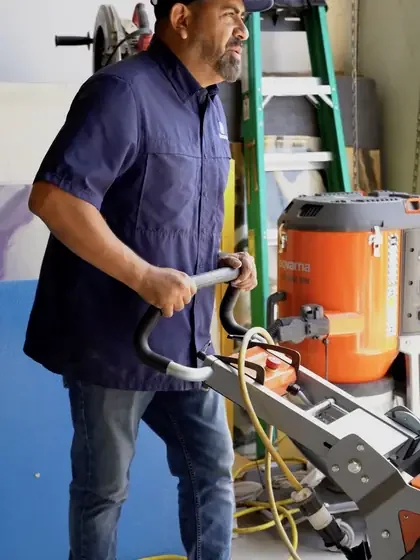
Diamond grinding with HEPA extraction: the step that decides whether a coating bonds.
Prep, moisture and joints
If a commercial floor failed before, one of these three is usually why. Each guide explains the test, the fix and the product.
Moisture & vapor drive
Why epoxy blisters on damp slabs, how to run an RH probe or calcium chloride test, and when a vapor barrier primer is required.
Moisture testing guide →Joints, cracks & spalls
Semi-rigid polyurea joint filler, rapid-set repair mortars and crack stitching, so forklift wheels stop chewing the joint edges.
Patch & joint repair →Choosing the right system
Epoxy, polyaspartic, urethane cement or MMA. A plain-language walk through how we match the system to the room.
System selection guide →Serving five Southern California counties from Corona
Riverside, San Bernardino, Orange, Los Angeles and San Diego Counties. The Inland Empire distribution corridor along the 10, 15, 60 and 215 is 15 to 45 minutes from our warehouse.
Commercial flooring FAQ
Do you install commercial floors, or only sell the material?
Both. Empire Coating Solutions installs commercial and industrial floors across Southern California, and we are also the material supplier, so the crew on your floor is using systems we stock, train on and warranty support from our Corona warehouse. If you already have a flooring contractor, we can supply that contractor and provide the spec.
Is there a minimum job size?
No. We quote everything from a single back-of-house kitchen to a full distribution center. Commercial and industrial floors are priced by spec rather than a flat per-square-foot rate, because the system, thickness, prep and schedule all change the number. Send the square footage and what the floor does and we will give you a real quote.
Can you work around our operations?
Yes. Most commercial work is phased by zone, done nights or weekends, or scheduled into a shutdown window. Fast-cure polyaspartic and MMA systems can return a section to service the same day, and urethane cement is typically back in foot traffic within a day. We build the phasing plan with your operations lead before anyone grinds.
What is the difference between epoxy and urethane cement?
Epoxy is a thin-build resin coating, usually measured in mils, with excellent adhesion, chemical resistance and finish options. Urethane cement is a thick cementitious urethane mortar, typically 1/8 to 1/4 inch, built for thermal shock, hot washdowns, steam and moisture. Dry warehouses, showrooms and labs usually get epoxy. Kitchens, food processing, breweries and freezers usually get urethane cement. Our kitchen flooring guide walks through the decision.
How long does a commercial epoxy floor last?
A properly prepped 100% solids epoxy or polyaspartic floor in a commercial space typically lasts 10 to 20 years before it needs a recoat, and the recoat is a fraction of the original cost. Failures almost always trace back to skipped moisture testing or weak surface prep, not the coating itself, which is why every one of our jobs starts with a moisture check and diamond grinding.
Where do you work?
Riverside, San Bernardino, Orange, Los Angeles and San Diego Counties, from our warehouse in Corona. We have coated warehouses, labs, gyms, retail and mall floors, commercial kitchens, schools, fire stations, aircraft hangars and military facilities throughout the region since 2000.
Guides for facility managers and GCs
Send us the floor. We'll send a real quote.
Square footage, what the room does, and a few photos is enough to start. Estimates within 24 hours, and a site walk for anything over a single room.
Corona warehouse open weekdays from 7:30 AM · 284 Dupont Street, Suite B #155, Corona, CA 92879 · Serving Riverside, San Bernardino, Orange, Los Angeles and San Diego Counties