
Epoxy Coatings for Concrete Floors
Every epoxy coating we stock and install, in one place: 100% solids body coats, water-based epoxies, primers, metallic clear, patch compounds, ESD systems and the polyaspartic topcoats that go over them. Prices are what you pay at our Corona counter. Material ships direct or picks up same day, and our crew installs across Riverside, San Bernardino, Orange, Los Angeles and San Diego counties.
Pick the epoxy by the job, not the brand
Epoxy is a family, not one product. The body coat under a garage floor, the primer under a commercial kitchen and the clear base of a metallic floor are all epoxies with different solids content, build and cure. Here is how we sort what we stock.
100% solids epoxy
The workhorse. No solvents, high build, the body coat under most flake, quartz and solid-color floors. Thicker film per coat than water-based, longer pot life management, best wear resistance of the epoxy family.
Water-based epoxy
Thin, low-odor, easy to roll. Used as a primer, a sealer on tight concrete, or the whole system in occupied spaces where solvent smell is a problem. Lower build than 100% solids.
Epoxy primers
Penetrating primers that lock down dust, tie the system to the slab and reduce outgassing bubbles in the body coat. Required under urethane cement and most high-build systems.
Metallic epoxy
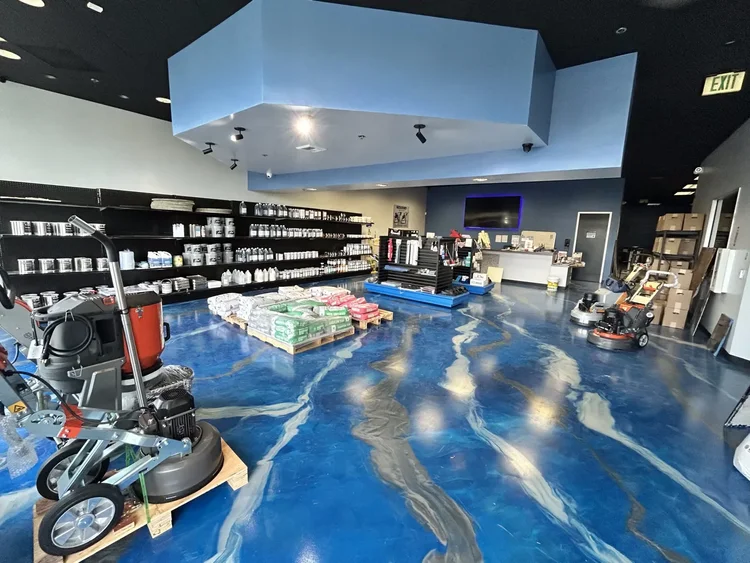
Clear 100% solids epoxy poured with metallic pigments for the marbled, three-dimensional floors in showrooms, restaurants and garages. Our Corona showroom floor is one.
Epoxy patch & mortar
Epoxy mixed with aggregate to fill cracks, spalls and joints so the finished floor is flat and the coating does not telegraph the damage.
- Kretus Top Shelf Epoxy Patch$153.88
Topcoats over epoxy
Epoxy yellows and dulls in UV. A polyaspartic or polyurethane topcoat holds the color, adds scratch resistance and gives you the slip profile. Every exterior or sunlit epoxy floor gets one.
ESD and conductive
Static-dissipative and conductive topcoats for electronics assembly, labs and any floor with a grounding spec.
Which coating for which floor
| Coating | Best for | Build | Cure / return to service | Starts at |
|---|---|---|---|---|
| 100% solids epoxy | Body coat for flake, quartz, solid color; garages, shops, warehouses | High build (E-FLO: 7.9 mil in one coat) | Foot traffic ~8 hrs, full cure 7 days (E-FLO P100) | E-FLO P100 from $137.89 / 3 gal |
| Water-based epoxy | Primers, sealers, occupied buildings, low-odor jobs | Thin film | Recoat same day on most jobs; see TDS | Kretus WB Epoxy $119.18 |
| Epoxy primer | Under urethane cement, moisture-prone slabs, high-build systems | Penetrating | Per TDS | EucoFloor Epoxy Primer $481.35 |
| Metallic epoxy | Showrooms, restaurants, garages, retail | 100% solids clear + pigment | Walk-on next day; topcoat recommended | Kretus Metallic Clear $210.22 / 3 gal |
| Polyaspartic topcoat | UV-exposed floors, fast turnaround, final wear layer | Thin, hard, UV-stable | Return to service in hours | Kretus Polyaspartic $200.26 |
| Urethane cement | Commercial kitchens, food plants, thermal shock, heavy chemicals | Thick slurry / mortar | Per TDS | See /urethane-cement-flooring |
Cure times are typical at 70°F and 50% humidity. The product's technical data sheet is the authority on every job; ask at the counter or see technical data.
Epoxy is a system, not a can of paint
The coating that lasts is the one that bonded to clean, open concrete. Every epoxy floor we install or supply follows the same sequence, and the sequence is why some floors peel in a year and others run fifteen.
1. Mechanical prep
Diamond grinding opens the slab to a CSP 2–3 profile and removes sealers, paint and laitance. Acid etching is not prep. We rent Husqvarna grinders and dust extractors from the Corona shop for contractors and DIY installs.
2. Repair and moisture
Cracks, spalls and joints get epoxy patch. Slabs with moisture or no vapor barrier get a moisture-tolerant primer or a vapor-blocking epoxy before the body coat; a calcium chloride or RH test tells you which.
3. Prime and body coat
A primer where the system calls for it, then the 100% solids epoxy body coat. This is where flake or quartz is broadcast to rejection for a textured floor, or where metallic pigments are poured for a marbled one.
4. Topcoat
A polyaspartic or polyurethane topcoat seals the broadcast, carries the UV and scratch resistance, and sets the slip profile. Skip it only on interior solid-color floors that never see sun.
Want to run it yourself? Our two-day hands-on epoxy class in Corona covers all four steps on real floors, with the material and grinders in the same building you buy them from.
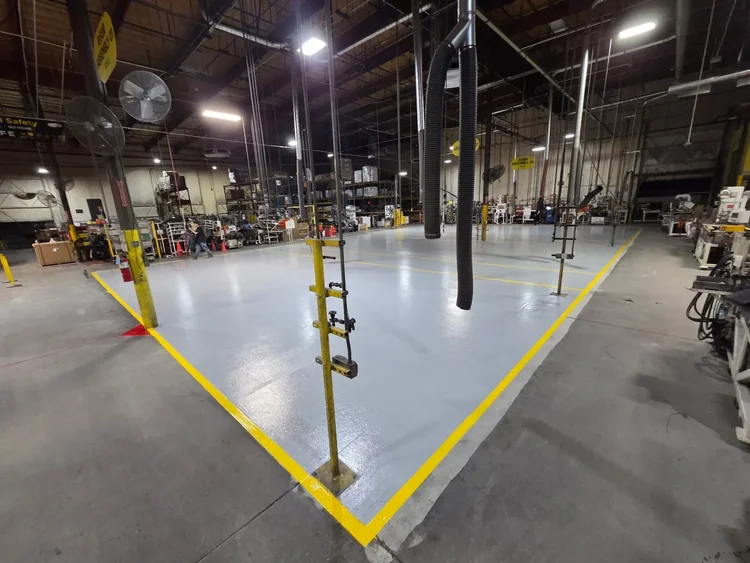
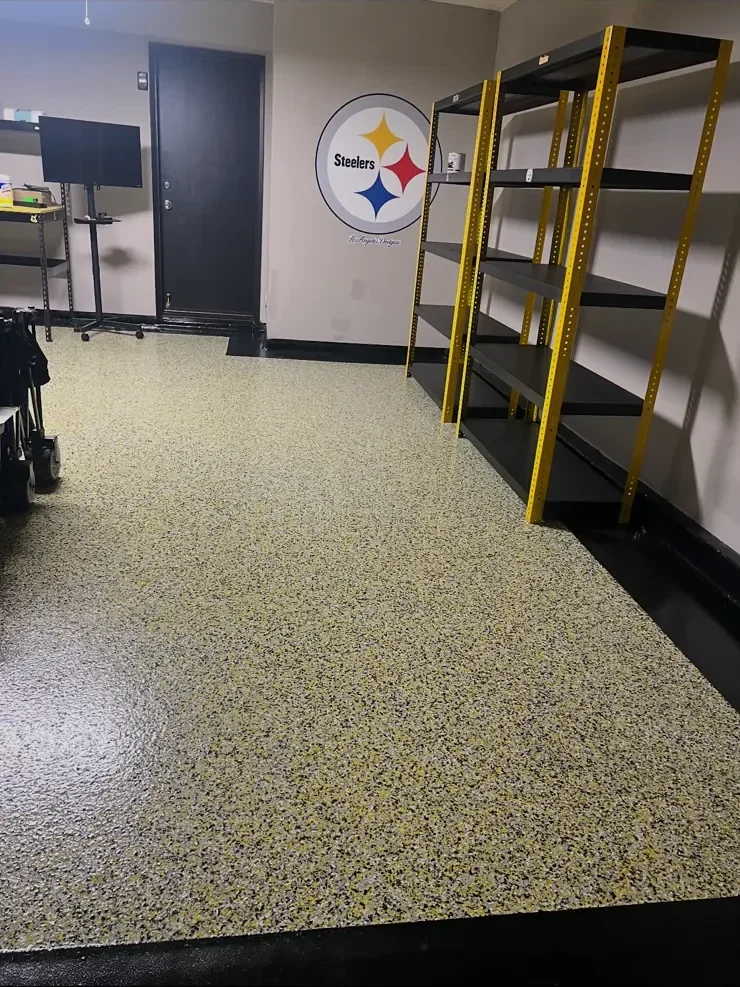
Epoxy floors we have installed
Epoxy coating questions
What is an epoxy coating?
A two-part resin and hardener that cure into a hard, bonded plastic film on concrete. Floor epoxies are sold as 100% solids (no solvent, high build), water-based (thin, low odor) and as primers, patch compounds and clear metallic bases. Most finished floors are a system: primer, epoxy body coat, broadcast flake or quartz, and a polyaspartic or urethane topcoat.
How much does epoxy coating cost?
Material: E-FLO P100 is $137.89 for a 3 gallon kit that covers about 390 sq ft per coat, so a two-car garage body coat is two kits. Kretus Top Shelf 100% Solids is $195.88, water-based epoxy $119.18, and polyaspartic topcoat $200.26. Installed by a crew, flake floors in Southern California run about $5.50 to $6.50 per sq ft, metallics and quartz $10 to $14, with prep extra. See our California epoxy cost page for the full breakdown.
Is epoxy or polyaspartic better?
They do different jobs. Epoxy is the thick, economical body coat that bonds to the slab and carries the flake. Polyaspartic is the thin, UV-stable, fast-curing topcoat that keeps the floor from yellowing and adds scratch resistance. Most professional floors use both: epoxy base, polyaspartic top. Polyaspartic-only systems exist for one-day jobs but cost more in material.
Will epoxy yellow in the sun?
Yes. All epoxies amber under UV. For garages with the door open all day, patios, walkways and anywhere with windows, put a polyaspartic or aliphatic polyurethane topcoat over the epoxy, or use the epoxy only as the base of a flake system where the topcoat is the visible layer.
How long before I can drive on an epoxy floor?
Depends on the product and temperature. E-FLO P100 takes foot traffic in about 8 hours and reaches full cure in 7 days; most 100% solids epoxies want 3 to 7 days before vehicles. A polyaspartic topcoat shortens that to a day or two. The TDS for each product is the authority.
Do you sell to the public or only contractors?
Both. Homeowners, facility managers and contractors all buy at the Corona counter or online with pickup or direct shipping. Contractors get contractor pricing, grinder rentals and the two-day epoxy training class.
Do you install epoxy coatings?
Yes. Empire Coating Solutions installs floors across Riverside, San Bernardino, Orange, Los Angeles and San Diego counties, and supplies the same material to independent contractors who want to run the job themselves.
Need epoxy today, or a crew to put it down?
Call the counter for stock and contractor pricing, or send the floor details for an install estimate. Southern California only; we are not a national mail-order shop.
Every concrete coating, by the job it does
Epoxy, polyaspartic, urethane cement, MMA, sealers, overlays, deck coatings and repair, compared on one page with counter prices.