
Warehouse Floor Coatings
Epoxy and mortar systems built for forklifts, racking and dock traffic
A warehouse floor fails at the joints, the dock and the turning lanes long before it fails in the middle of an aisle. We fix the slab first, then install a 100% solids epoxy or Hermetic mortar system matched to your traffic, phased so the building keeps shipping.
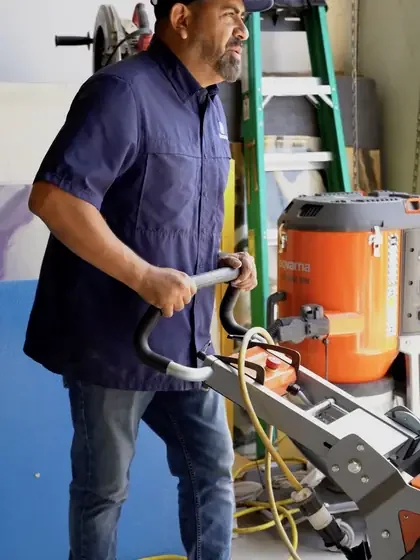
Why warehouse floors wear out
Bare concrete was never meant to be the wear surface. Here is what actually breaks a distribution floor, and what we do about each one.
Joint spalling
Solid forklift wheels hit every saw-cut joint thousands of times a day. The edges chip, the chips become potholes, and the potholes break pallets and wheels.
Joint repair →Dusting & abrasion
Weak surface paste turns into concrete dust that coats inventory and clogs equipment. Grinding to sound concrete and sealing it stops the source.
Densifiers & sealers →Moisture & vapor drive
Slabs on grade push water vapor up through the concrete. Coat over it untested and the floor blisters in the first summer.
Moisture testing →Oil, battery acid & impact
Charging areas, maintenance bays and docks see spills and dropped loads that plain epoxy was not designed for. Those zones get a different spec.
Heavy-duty mortars →One building, several floors
We do not coat a 200,000 square foot warehouse with one system. Each zone gets the build it needs, which keeps the budget on the traffic that earns it.
| Zone | What it takes | System we spec |
|---|---|---|
| Main aisles & racking bays | Constant forklift traffic, point loads from rack legs, pallet drag | 100% solids epoxy primer and body coat with broadcast aggregate, polyaspartic or urethane topcoat. Joints filled with semi-rigid polyurea. |
| Dock & staging | Dock plates, hard turns, dropped loads, daylight through the doors | Thicker build: double-broadcast quartz (Stout) or Paramount slurry, UV-stable topcoat |
| Battery charging & maintenance | Acid, oil, coolant, impact from tools and parts | Chemical-resistant epoxy system with cove base and containment detailing; novolac where the spec requires it |
| Cold storage & freezers | Sub-zero temperatures, condensation, no downtime window | MMA fast-cure resin, or urethane cement where thermal cycling is severe |
| Offices, break rooms, restrooms | Foot traffic, appearance, easy cleaning | Solid color epoxy, flake or quartz broadcast with a satin topcoat |
| Mezzanines & pick modules | Steel or wood decks, foot traffic, slip resistance | Flexible epoxy or urethane system with anti-slip aggregate, specified by deck type |
Striping, lanes and walkways in the coating
Painted lines on bare concrete last a few months under forklifts. Lines applied as part of the coating system, in the same resin as the floor, last as long as the floor does. We lay out and install:
- Forklift lanes and pedestrian walkways in safety yellow
- Hazard and keep-clear zones at docks, charging stations and fire equipment
- Rack footprints, staging boxes and pallet positions
- Color-coded zones for pick areas, returns and quarantine
- Anti-slip texture stepped up in wet entries and dock aprons
The layout follows your safety program and the conventions your insurer or OSHA consultant uses. Bring the drawing, or we will mark it out with your floor supervisor.
How we phase a live warehouse
1. Walk the building with operations and map zones to shipping priorities.
2. Night and weekend windows for grinding, with HEPA dust extraction so inventory stays clean.
3. Fast-cure polyaspartic or MMA where a lane has to reopen by the next shift; standard epoxy where a bay can rest overnight.
4. Temporary barricades and clear release times posted per zone.
5. Final striping once the full floor is down, so the lines meet.
What happens before the coating goes down
Moisture test
In-slab RH probes (ASTM F2170) or calcium chloride (ASTM F1869). High readings get a vapor barrier primer in the spec.
Grind or shot blast
Remove sealers, curing compounds, laitance and old coatings. Profile the slab to the ICRI standard the system calls for.
Joints & repairs
Clean and fill control joints with semi-rigid polyurea, rebuild spalled edges with rapid-set mortar, rout and fill cracks.
Prime & build
Penetrating primer, 100% solids body coat, aggregate broadcast for traction, back-roll, cure.
Topcoat & stripe
Polyaspartic or urethane topcoat for abrasion and UV, then lanes, walkways and hazard zones in the same system.
Inland Empire warehouse country is 15 to 45 minutes away
From the Ontario airport logistics parks to the distribution centers along the 215 in Perris and Moreno Valley, most of the region's big-box inventory sits within a short drive of our Corona warehouse. We also cover the industrial cities of Orange, Los Angeles and San Diego Counties.
Warehouse flooring FAQ
What is the best floor coating for a warehouse with forklift traffic?
For most dry warehouses, a 100% solids epoxy system with a broadcast aggregate for traction, topped with a polyaspartic or urethane topcoat where there is daylight or heavy abrasion. Where forklifts turn hard, drop pallets or run at the dock, we step up to a thicker Hermetic mortar system. The joints matter as much as the coating: fill them with a semi-rigid polyurea so wheels stop breaking the edges.
Do we have to shut the warehouse down?
Usually not all at once. We phase by aisle, zone or bay, work nights and weekends, and use fast-cure polyaspartic or MMA where a section has to be back in service the same shift. A typical phase is grind, repair and prime one day, coat the next, and release it the day after. The schedule is built with your operations lead before work starts.
How do you handle the control joints and cracks?
Saw-cut control joints get cleaned out and filled with a semi-rigid polyurea joint filler such as Euclid QWIKjoint UVR, shaved flush so wheels roll over them without impact. Random cracks are routed and filled or stitched, and spalled joint edges are rebuilt with a rapid-set repair mortar before the coating goes down. We do not coat over open joints; that is how coatings crack along the joint lines.
Can you coat over an old, dusting or sealed warehouse slab?
Yes, after preparation. Dusting slabs are ground to sound concrete and sometimes densified first. Old sealers and curing compounds are removed by diamond grinding or shot blasting, because nothing bonds to them. Every slab is moisture tested first; a slab with high vapor drive gets a vapor barrier primer so the floor does not blister later.
How much does a warehouse floor coating cost?
Warehouse floors are quoted by spec, not a flat rate. The square footage, how much joint and spall repair the slab needs, the system thickness, the aggregate and topcoat, striping and the phasing schedule all move the number. Our published ranges for standard epoxy systems are on the California cost page; for a warehouse, send the square footage and photos of the joints and we will quote it properly.
Which areas do you cover for warehouse work?
The Inland Empire distribution corridor is our home turf: Ontario, Fontana, Rancho Cucamonga, Chino, Eastvale, Jurupa Valley, Riverside, Moreno Valley, Perris, Redlands and San Bernardino are all within about 45 minutes of our Corona warehouse. We also cover the industrial cities of Orange and Los Angeles Counties, including Santa Fe Springs, Anaheim, Irvine, Torrance and Long Beach, and San Diego County.
More for facility and operations managers
Send the square footage and a photo of the joints. We'll quote it.
Warehouse floors are quoted by spec. Tell us what runs on the floor and when the building can give us a window, and we will come back with a system, a phasing plan and a number.
Corona warehouse open weekdays from 7:30 AM · 284 Dupont Street, Suite B #155, Corona, CA 92879 · Serving Riverside, San Bernardino, Orange, Los Angeles and San Diego Counties