
Ask five installers for the best garage floor coating and you'll get five answers, usually whatever they happen to sell. We sell and install almost all of them out of our Corona shop, so here's the honest comparison: what each option costs, how long it holds up in Southern California heat, and which one we'd put in our own garage.
For most garages, the best coating is a full-broadcast flake system with a polyaspartic topcoat over a diamond-ground slab. It hides cracks and dirt, resists hot tires and oil, stays color-stable in sun, and runs about $5.50–$6.50 per sq ft plus prep. Choose metallic for a showpiece, quartz for a work shop, and skip one-part epoxy paint.
Every garage floor coating, compared
| Coating | Durability | Hot tires & sun | Installed cost | Verdict |
|---|---|---|---|---|
| 1-part epoxy paint / big-box kit | Low | Poor; lifts and ambers | Lowest (DIY) | Skip it |
| Concrete sealer / densifier | Moderate | Fine | Low | Good for dust-proofing bare concrete only |
| Solid-color 100% solids epoxy | Good | Fair; needs a UV topcoat | Quoted per job | Budget pick that actually lasts |
| Flake epoxy + polyaspartic topcoat | Very high | Excellent | $5.50–$6.50/sq ft + prep | Best for most garages |
| Full polyaspartic system | Very high | Excellent | Quoted per job | When speed matters most |
| Metallic epoxy | High | Good with topcoat | $10–$14/sq ft | Showroom look |
| Quartz broadcast | Highest | Excellent | $10–$14/sq ft | Work shops, wet areas |
| Concrete overlay | High | Good when sealed | Quoted per job | Rebuilding a damaged surface |
| Interlocking tiles / mats | Moderate | Good | Varies | Renters; hides but traps water |
Prep (grinding plus crack and spall repair) adds $1–$3 per sq ft to any coated system. Full numbers: epoxy flooring cost in California.
1. One-part epoxy paint: why we tell people to skip it
Most "epoxy" garage kits are water-based acrylic or one-part epoxy-modified paint. They go on thin, they're applied over concrete that was only acid-etched or washed, and they're the floors we grind off most often. The classic failure is hot tire pickup: you park after a summer drive, the tire softens the coating, and it peels up when you back out. If you want to DIY, use real two-part 100% solids material and grind first.
2. Solid-color epoxy: the honest budget option
A two-part, 100% solids epoxy in a solid color is a real floor. It's thick, hard, and resists oil and chemicals. The trade-offs: it shows dust, tire marks and every flaw in the slab, it can be slippery when wet, and bare epoxy ambers in sun unless it gets a UV-stable topcoat. Good for storage rooms and budget jobs; for a garage you park in, flake is worth the step up.
3. Flake epoxy with a polyaspartic topcoat: our pick
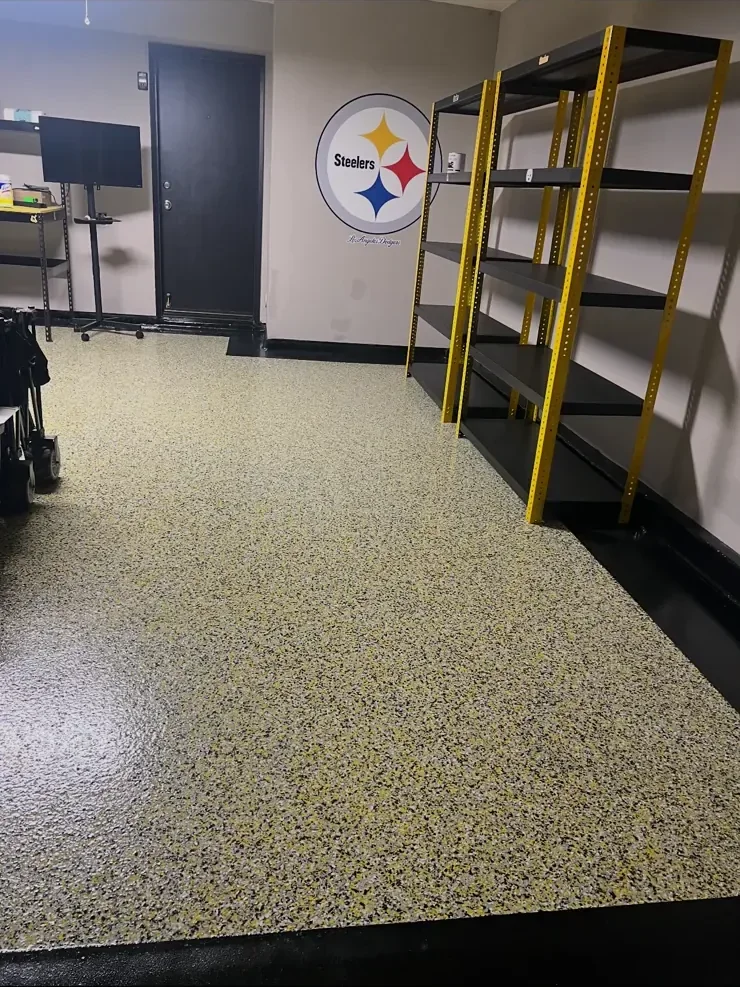
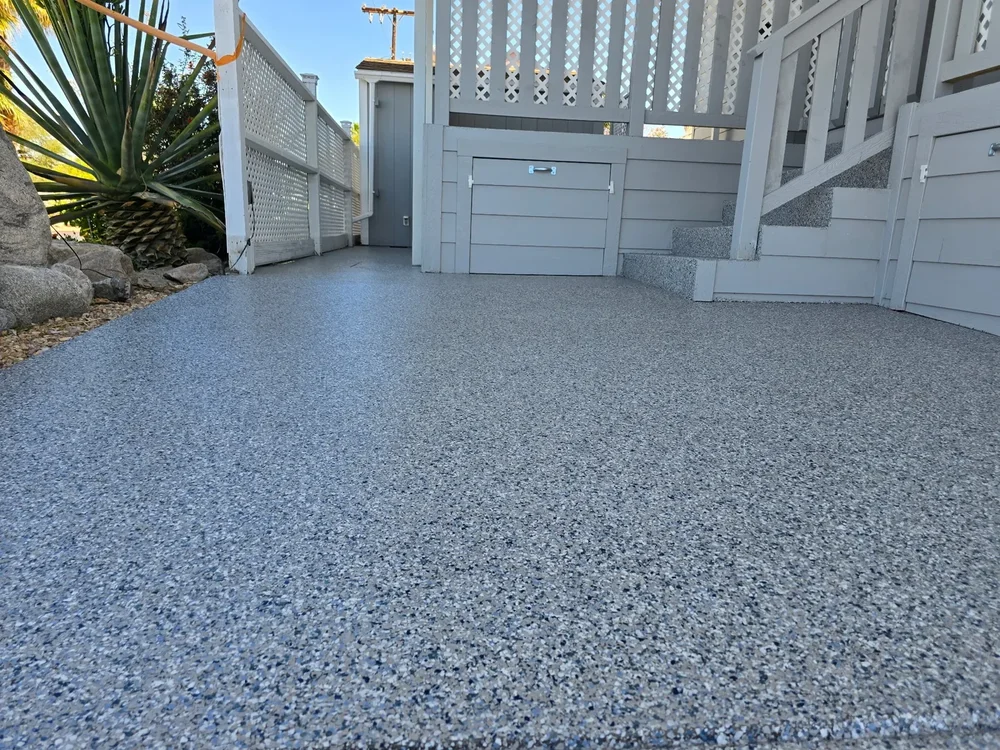
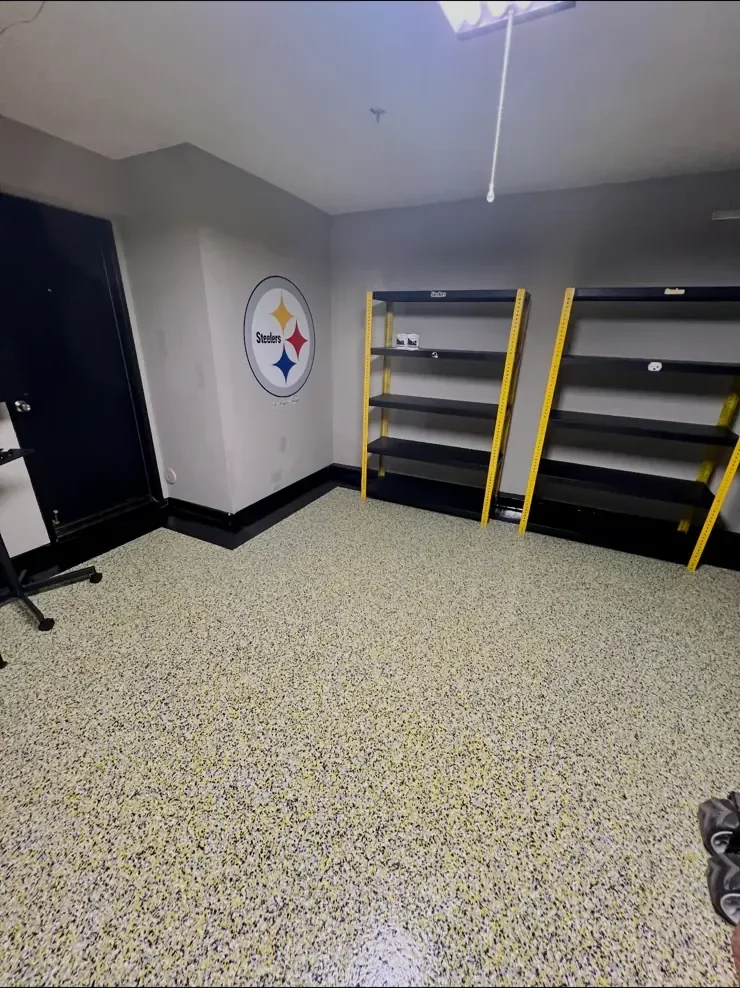
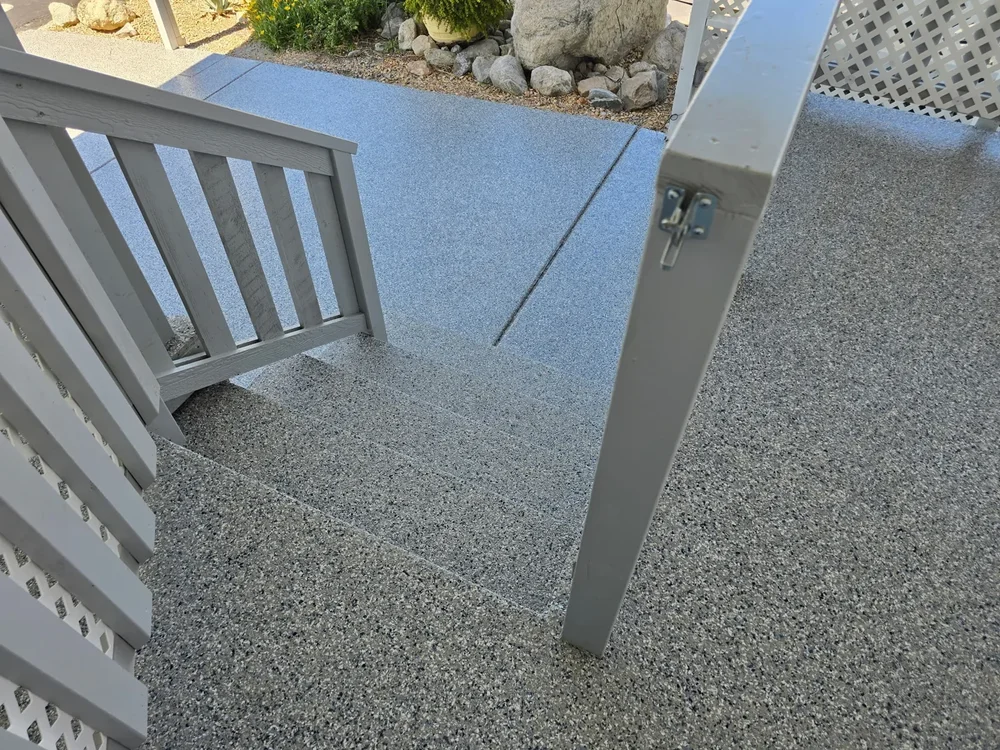
This is the system we install on most garages and the one we'd put in our own. The build: diamond grind, repair cracks, pigmented base coat, vinyl flake broadcast to full coverage, then a clear polyaspartic topcoat.
- Hides everything: dust, tire marks, patched cracks and minor slab flaws disappear in the flake pattern.
- Built-in texture: the flake gives more grip than a smooth floor, and you can add anti-slip grit to the topcoat.
- Handles SoCal: the polyaspartic top is UV-stable and resists hot tires and temperature swings.
- Easy to live with: oil and spills wipe up; a damaged spot can be repaired and blended.
4. Full polyaspartic: when speed is the priority
Building every layer from polyaspartic shortens recoat times from overnight to a few hours, which is what makes one-day installs possible. It costs more, has a very short working time (not DIY-friendly), and leaves no margin for a damp slab. Read what "one-day" really means before you choose it for speed alone.
5. Metallic epoxy: the showpiece
Pigmented epoxy manipulated into a marble or lava look, sealed under a clear topcoat. It's the floor people photograph. It also shows scratches and dust more than flake does, and it costs roughly twice as much. See metallic epoxy floors.
6. Quartz broadcast: for work shops
Colored quartz sand broadcast into epoxy is the toughest, most slip-resistant resin floor. It's what commercial kitchens use. In a home garage it's overkill unless you're running a shop, washing equipment or working on cars daily.
7. Concrete overlays: when the surface itself is shot
If the slab is heavily scaled, pitted or uneven, a polymer-modified cement overlay rebuilds the surface. It can be smooth, textured, stained or stamped, and it's the only option on this list that can match a driveway or patio. In a garage it should be sealed or coated on top. See garage floor resurfacing.
8. Tiles and mats
Interlocking tiles are removable and need no prep, which makes them popular with renters. They trap water and grit underneath, can shift under hot tires, and don't protect or fix the concrete. A fine stopgap; not a coating.
How to choose
- Park in it and want it to last: flake + polyaspartic.
- Need it back in a day: full polyaspartic, if the slab tests dry.
- Want a showpiece: metallic.
- Run a shop: quartz.
- Slab is badly damaged: resurface first, then coat or overlay.
- Tight budget: solid epoxy with a UV topcoat, or DIY with a rented grinder and real material.
The part nobody advertises: the coating matters less than the prep. Every system above fails on a slab that wasn't ground or that has moisture coming up through it. Ask any installer how they prep and whether they test for moisture before you compare prices. (Why garage coatings fail in Southern California.)
Frequently asked questions
What is the most durable garage floor coating?
For a residential garage, a full-broadcast flake system with a polyaspartic topcoat is the most durable option for the money: the flake adds thickness and texture, and the polyaspartic top resists hot tires, chemicals and UV. Quartz-broadcast systems are tougher still and are used in commercial kitchens and shops, but they cost more and are rougher underfoot.
Is epoxy or polyaspartic better for a garage floor?
Use both. Epoxy makes a strong, affordable base coat; polyaspartic makes the better topcoat because it is UV-stable and handles hot tires and temperature swings. A hybrid system is what most professional installers in Southern California put down.
Are DIY epoxy kits worth it?
Water-based one-part 'epoxy' paints from big-box stores are thin and usually fail within a year or two where hot tires park, especially if the slab wasn't ground. A 100% solids two-part epoxy on a properly ground slab is a real coating and can be a good DIY project. The prep, not the product, is what decides whether a DIY floor lasts.
What is the cheapest garage floor coating that actually lasts?
A solid-color 100% solids epoxy base with a clear topcoat on a ground slab is the lowest-cost system we would call durable. If you want to save on installation, rent a grinder and do it yourself with professional-grade material rather than buying a paint kit.
How much does a professional garage floor coating cost?
Full-broadcast flake floors run about $5.50 to $6.50 per sq ft installed, plus $1 to $3 per sq ft for grinding and repair. A typical 400 sq ft 2-car garage lands around $2,600 to $3,800. Metallic floors run about $10 to $14 per sq ft.
What garage floor coating is best for hot climates like Southern California?
Pick a system with a UV-stable topcoat (polyaspartic or aliphatic urethane) and real film thickness. Heat makes hot tire pickup worse and sun ambers bare epoxy, so a thin epoxy paint is the worst choice in our climate. Test the slab for moisture too: summer heat drives vapor up through older slabs.
Not sure which one fits your garage?
Send us photos and the size. We'll tell you which system fits the slab and your budget, and give you a range within one business day.
Free EstimateBrowse Flake Colors