
Garage Floor Resurfacing in Corona & Southern California
If your garage slab is cracked, pitted, oil-stained or covered in a peeling DIY coating, you don't need to tear it out. Resurfacing gives you a brand-new wear surface on the concrete you already have: we grind it, repair it and lock it in under a coating built for Southern California heat.
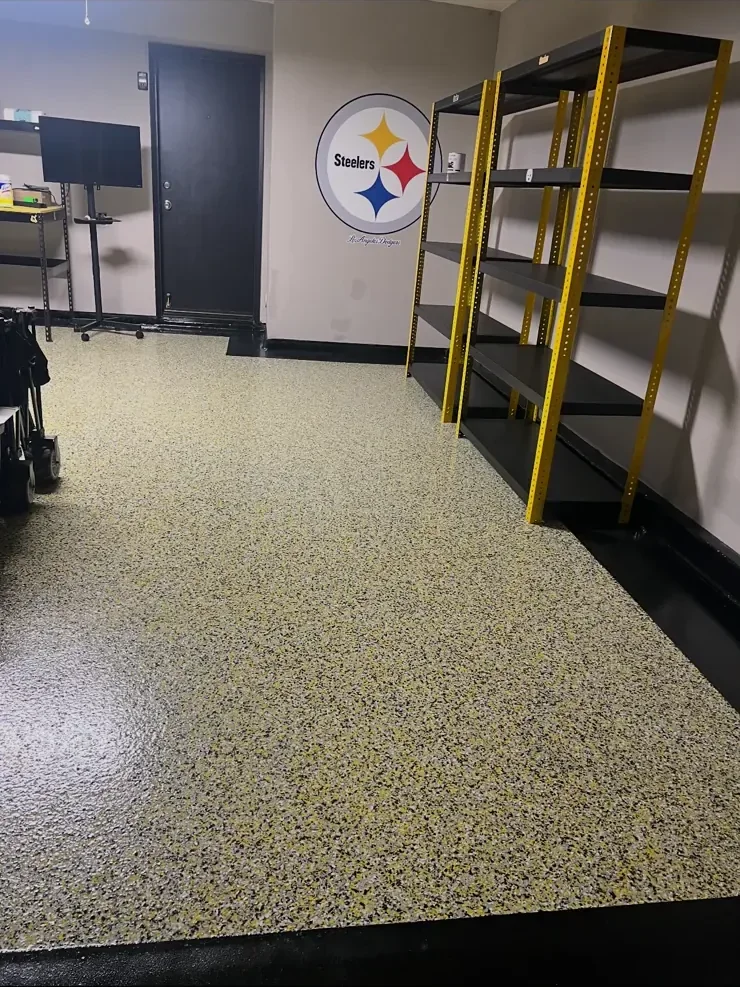
Garage floor resurfacing means diamond-grinding the slab, repairing cracks, spalls and pitting, and then applying a new surface: usually a flake system with a UV-stable polyaspartic topcoat, or a cement-based overlay when the surface itself needs rebuilding. A typical 2-car garage with flake runs about $2,600–$3,800 installed.
Signs your garage floor needs resurfacing
- Cracks and spalls: shrinkage cracks, chipped control joints and broken edges that trap dirt and keep growing.
- Pitting and scaling: a rough, sandy or flaking surface that never looks clean no matter how often you sweep.
- Oil and tire stains soaked into bare concrete.
- A failing coating: peeling paint or a big-box epoxy kit lifting where hot tires park (hot tire pickup).
- Dust: bare concrete that keeps shedding a fine powder onto everything stored in the garage.
If the slab is sinking, heaving or has cracks that are still opening, that is a structural problem, not a surface one. We'll tell you if that's what we see.
Your resurfacing options
| Option | What it is | Best for |
|---|---|---|
| Grind, repair & flake coat | Diamond grind, fill cracks and spalls, base coat, full flake broadcast, polyaspartic clear topcoat | Most garages. Hides repairs, resists hot tires and oil, easy to clean. |
| Polyaspartic system | Same build with fast-cure polyaspartic layers | Sun-exposed garages, fast turnaround, one-day installs when conditions allow |
| Metallic epoxy | Pigmented epoxy with a marble-like finish, then a clear topcoat | Showroom garages and feature floors |
| Concrete overlay | Polymer-modified cement resurfacer applied smooth, knockdown or stamped, then sealed | Badly scaled or uneven slabs, stone and stained looks, garage-to-driveway continuity |
How we resurface a garage floor
- Inspect and test. We look at the cracks, joints and any old coating, and check the slab for moisture. Moisture coming up through the slab is the most common reason coatings fail, and it changes which primer we use. (Why moisture testing matters.)
- Diamond grind. Planetary grinders with HEPA dust extraction remove old coatings, stains and the weak top layer, and open the surface so the new system can bond.
- Repair. Cracks and joints are chased open and filled with a polyurea joint filler like Kretus Poly Patch; spalls and divots get an epoxy patch; low spots can be built up. Everything is shaved flush. (Our repair materials.)
- Base coat. A pigmented base coat goes down to wet out and seal the concrete.
- Flake broadcast or overlay. For flake floors we broadcast vinyl flake to refusal so the surface is fully covered, then scrape and vacuum the excess. For overlays, the cement resurfacer is troweled or textured.
- Topcoat. A UV-stable polyaspartic clear topcoat locks it in. If you want more grip, we add an anti-slip additive to this coat.
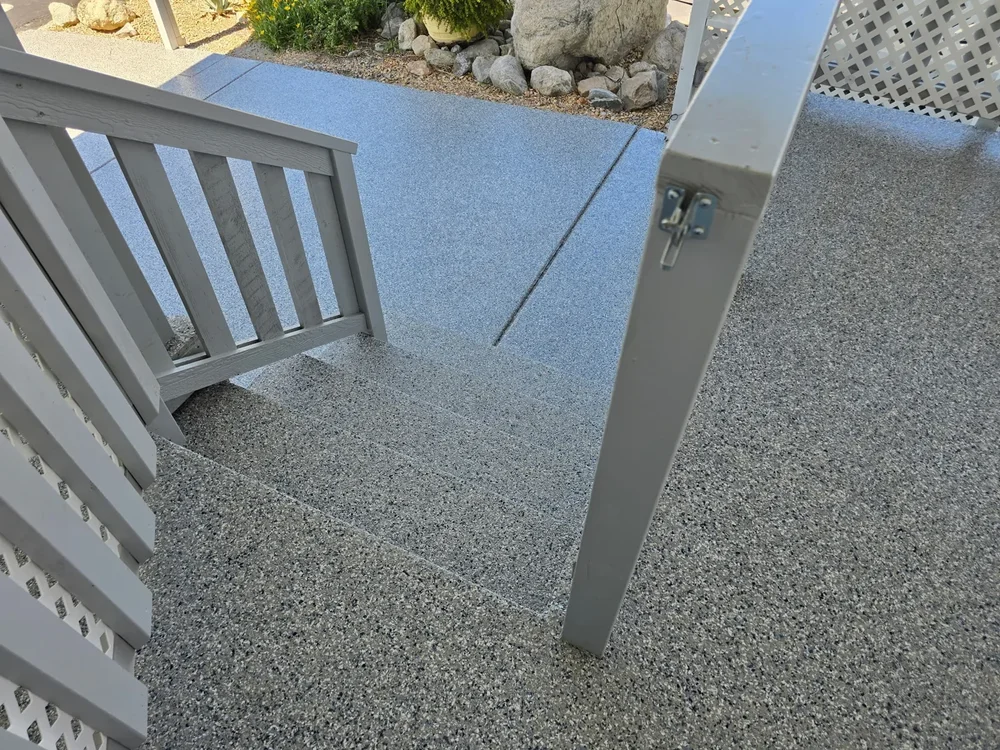
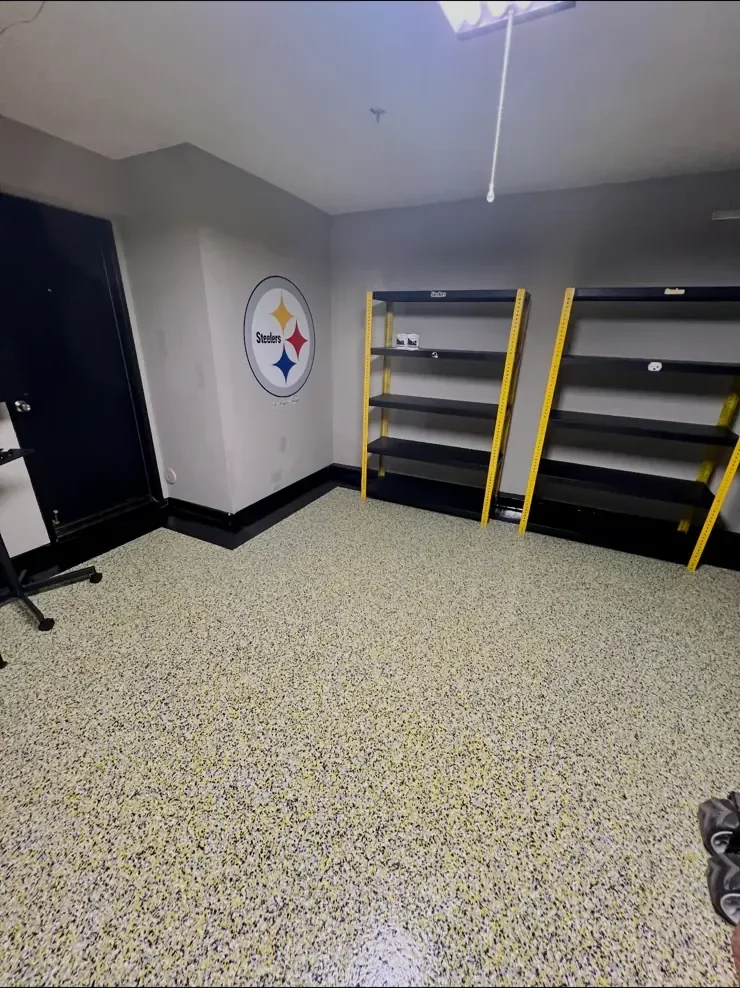
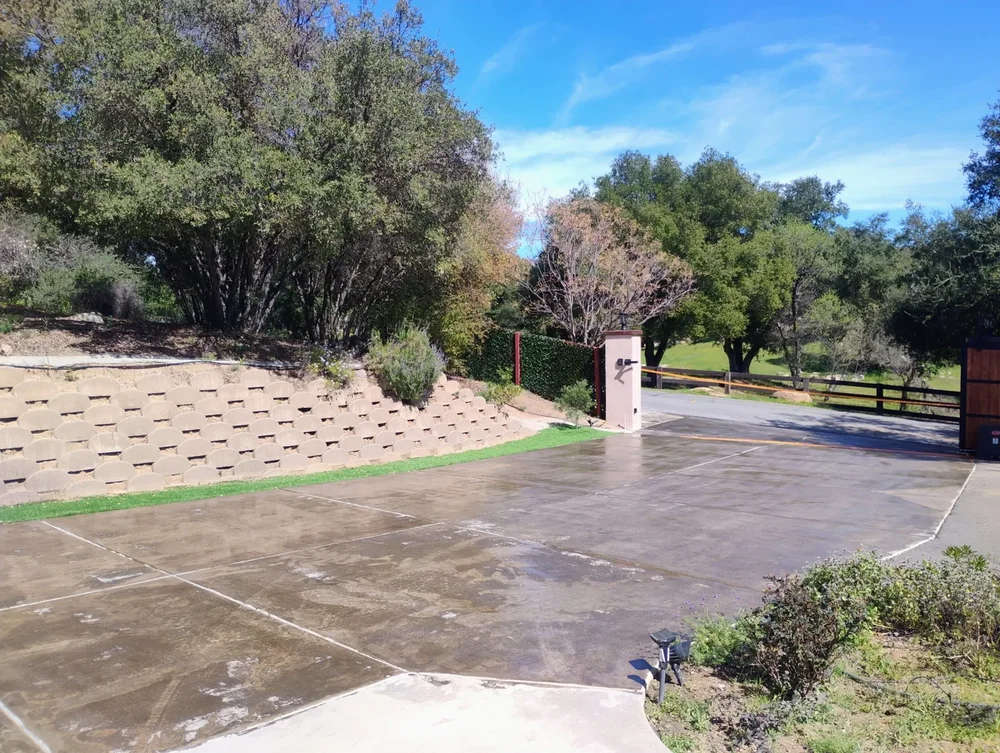
What garage floor resurfacing costs
For a full-broadcast flake system we publish $5.50–$6.50 per sq ft, plus $1–$3 per sq ft for grinding and repair depending on the slab. On a typical 400 sq ft 2-car garage that works out to roughly $2,600–$3,800 installed. Metallic floors run $10–$14 per sq ft. Concrete overlays and slabs that need heavy repair or coating removal are quoted after we see them.
The full price table and a calculator are on our epoxy flooring cost page.
Doing it yourself? We're also a supply store. Rent a concrete grinder and dust vacuum, pick up repair material, flake and topcoat at our Corona counter, or take our 2-day hands-on class first.
Where we resurface garage floors
We're based in Corona and resurface garage floors across Riverside, San Bernardino, Orange, Los Angeles and San Diego Counties, including Riverside, Eastvale, Norco, Chino Hills, Ontario, Rancho Cucamonga, Temecula, Murrieta, Yorba Linda and Anaheim Hills. English and Spanish spoken.
Garage floor resurfacing FAQ
Is it cheaper to resurface a garage floor or replace it?
Resurfacing is almost always far cheaper. Tearing out and repouring a garage slab means demolition, haul-off, forming, new concrete and weeks of cure time before you can coat it. As long as the slab is structurally sound, grinding, repairing and coating it gives you a new wear surface for a fraction of that, usually in a few days.
Can you resurface a garage floor with big cracks?
Yes, as long as the slab isn't actively moving or sinking. We grind the cracks open, fill them with a polyurea or epoxy repair material, shave them flush and coat over them. Hairline and shrinkage cracks disappear under a flake floor. Cracks that keep moving can show back through any coating, so we tell you up front if a crack needs to be treated as a joint.
How long does garage floor resurfacing take?
Most 2-car garages are one to three days on site depending on the system and how much repair the slab needs. A polyaspartic flake floor can often be installed in a single day. Plan on light foot traffic within about 24 hours and parking a car after the coating's full cure, which our installer will confirm for the product used on your floor.
What does it cost to resurface a 2-car garage?
For a typical 400 sq ft 2-car garage with a full-broadcast flake system, most jobs land between about $2,600 and $3,800 installed, including $1 to $3 per sq ft of grinding and repair. Concrete overlays and heavy repair work are quoted after we see the slab. See our epoxy flooring cost guide for the full breakdown.
Can you resurface over an old epoxy or painted garage floor?
Yes, but the old coating has to come off first wherever it is peeling or poorly bonded. We diamond-grind the floor back to sound material. Coating over a failing coating just bonds your new floor to something that is already letting go.
Is a concrete overlay or a flake coating better for a garage?
For most garages a flake coating is the better pick: it resists hot tires, oil and chemicals and is easy to clean. A cementitious overlay makes sense when the slab surface is badly scaled, uneven or pitted and needs to be rebuilt, or when you want a stone, stained or textured look. Overlays can be sealed or coated on top.
Get your garage floor quoted
Send a few photos and the rough size of the garage. We'll reply within one business day with a range, then confirm the number after we see the slab.
Free Estimate909-272-5137